Straumann vs Nobel Biocare: Which Implant System and When
Straumann (Switzerland) and Nobel Biocare (Sweden) are the two dominant premium implant brands globally — between them, they account for roughly 40% of the international implant market. Both have decades of published outcome data and excellent long-term survival rates. The differences between them are real but marginal for most clinical scenarios. Here is the honest comparison for UK patients.
The two brands at a glance
Straumann (Switzerland)
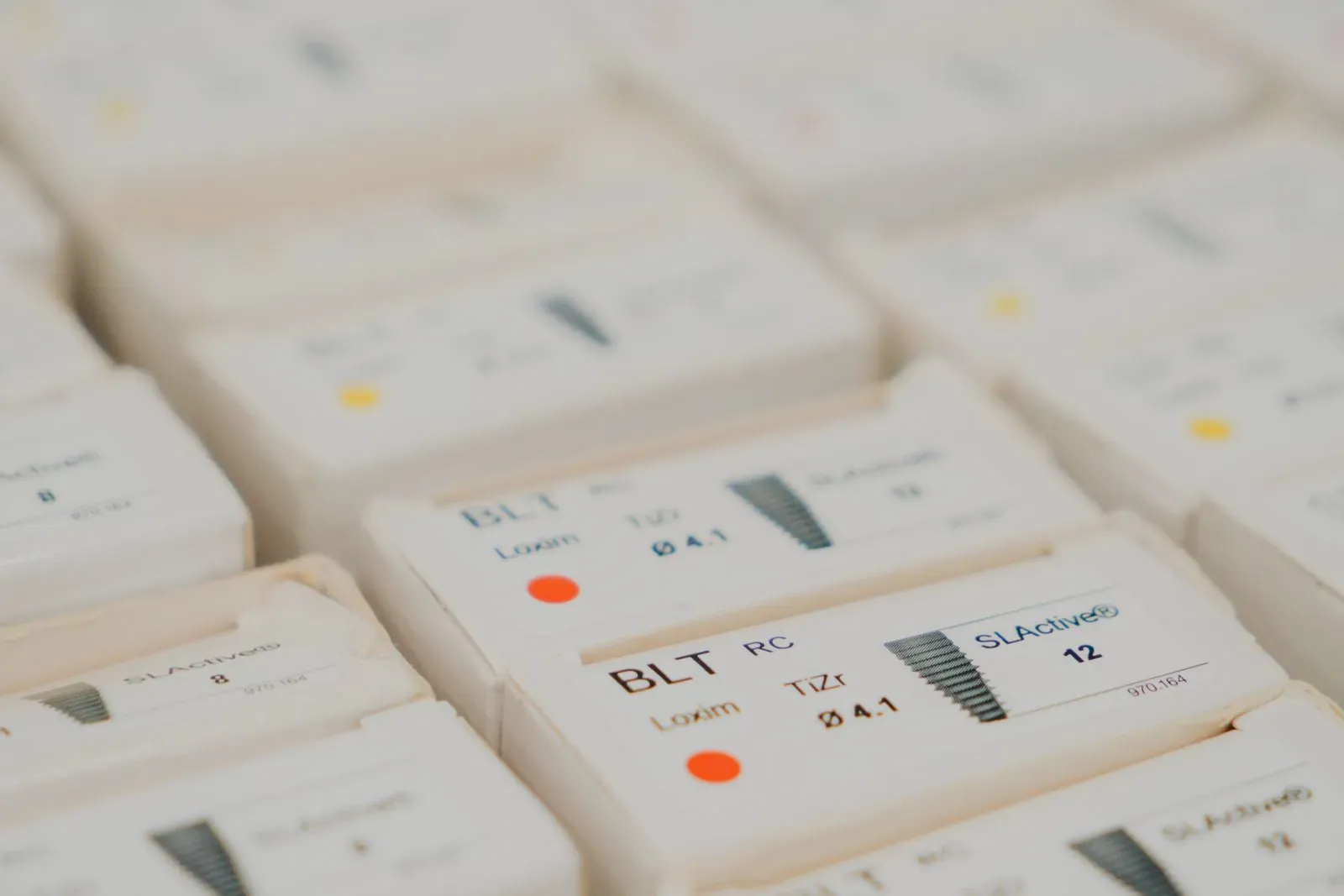
Founded in 1954. The largest implant manufacturer globally. Known for the SLA (sandblasted, large-grit, acid-etched) surface and the more recent SLActive surface. Bone-Level Tapered (BLT) is the current flagship for routine cases; BLX is the latest premium with hydrophilic surface for accelerated healing.
Nobel Biocare (Sweden)
Founded in 1981. The original developer of the modern dental implant (Brånemark protocol). Known for the TiUnite surface and the Nobel Active design. NobelActive is the workhorse; NobelParallel CC and NobelReplace are alternative designs for specific clinical situations.
The technical differences that matter clinically
Surface treatment
Both brands use roughened surfaces designed to encourage bone-implant contact. Straumann SLA/SLActive uses sandblast + acid etch + hydrophilic storage. Nobel TiUnite uses anodised titanium oxide. Both achieve excellent osseointegration; published outcomes are comparable.
Implant body design
Straumann BLT has a tapered body with deep threads for stability in soft bone. Nobel Active has an aggressive thread design with apical “self-tapping” features. Both are appropriate for immediate placement scenarios; Nobel Active has slight advantages in fresh extraction sites; Straumann BLT in healed ridges.
Connection type
Straumann uses an internal CrossFit (synOcta) connection. Nobel uses internal hex or Conical Connection. Both are stable; the differences are largely about prosthetic component compatibility — once you choose a brand, you generally stay within that brand’s prosthetic ecosystem.
Healing time
Standard healing protocol is 3–6 months for both. SLActive (Straumann) and TiUltra (Nobel) hydrophilic surfaces published with shorter osseointegration in some studies (2–4 months) — the difference is real but marginal for most clinical scenarios.
When the choice matters
For most routine cases, both brands deliver excellent outcomes. The choice matters more in specific scenarios:
Compromised bone
Patients with low-density bone (frequently post-extraction sites, diabetics, smokers) benefit from systems with hydrophilic surfaces and good primary stability. Both Straumann SLActive and Nobel TiUnite/Active perform well in compromised conditions.
Immediate placement and immediate loading
Nobel Active has a slight historical advantage for immediate placement protocols. Straumann BLX (premium) closed the gap for immediate loading.
All-on-4 cases
Nobel Biocare originally developed the All-on-4 protocol. Both brands now have well-established All-on-4 component sets. The choice is largely surgeon preference and prosthetic compatibility.
Aesthetic anterior cases
Pink-tissue management, soft tissue contour, and abutment-emergence design are important for visible-tooth implants. Straumann’s anatomical abutment range and Nobel’s NobelProcera CAD/CAM are both excellent options.
Long-term published data
Straumann has more published 20+ year follow-up data. For patients in their 40s having implants intended for 30+ year service, this is a marginal point in favour of Straumann.
Cost differences
Straumann and Nobel Biocare are similarly priced — both at the premium end of the implant market. Within each brand, the tiers (standard line vs premium hydrophilic surface) differ in cost. Other premium brands (Astra Tech, BioHorizons) are similar in cost and outcomes; the choice between any of these top-tier systems is largely operator preference.
Below this premium tier, Straumann Group offers Neodent and Medentika — value lines using the same Straumann manufacturing standards but at lower price points. These are appropriate for routine cases where the premium hydrophilic surface or specific features are not needed. Our broader implant types guide covers the spectrum.
The honest summary
For a UK patient asking “Straumann or Nobel?”, the realistic answer is that both will give excellent results in your case. The marginal differences between them matter less than the operator’s experience, the case planning, and the long-term maintenance. The brand alone does not determine outcome.
What does matter:
- The dentist’s experience with the specific system being used.
- Adequate pre-operative planning with CBCT.
- Proper aseptic technique.
- Quality of the prosthetic restoration (crown, bridge) on top of the implant.
- Long-term maintenance and patient compliance.
Choosing between Straumann and Nobel Biocare is a tier-3 decision after these tier-1 and tier-2 factors are addressed.
Lot certification and verification
Whichever system is used, you should receive lot certification at discharge — the manufacturer’s batch number for the specific implant placed in your mouth. This document allows future verification (in case of manufacturer recall, warranty claim, or insurance documentation). Reputable clinics provide this as routine; ask if it is not offered.
For UK patients in Istanbul
Pricing tiers covering both Straumann and Nobel Biocare options are on the packages page. Standard tier uses Straumann Group value lines (Neodent, Medentika); premium tier uses Straumann BLT or Nobel Active; VIP tier uses Straumann BLX premium. The choice within each tier depends on your specific case and surgeon preference. Lot certification is provided for every implant placed.
Frequently asked questions
Is Straumann really better than Nobel Biocare?
Marginally, in some specific scenarios — long-term published data, bone preservation in some studies. For most routine cases, both produce equivalent outcomes. The honest answer is that both are excellent and the brand choice is less important than the operator’s experience and the case planning.
Why are some implants cheaper than others?
Multiple factors. Premium brands (Straumann BLT/BLX, Nobel Active) cost more than value lines (Neodent, Medentika) within the same parent group. Beyond the Straumann Group, brands like Astra Tech, BioHorizons are at premium tier. Below that, regional brands and unbranded systems are cheaper but with less published data. The cost reflects R&D investment, surface treatment complexity, and component ecosystem depth.
Can my UK dentist work on a Straumann or Nobel implant placed abroad?
Yes. Both brands are available in the UK and most UK private clinics work with both. NHS provision is more limited for component-level work. The records pack from the placing clinic should include the brand, model, and lot number — your UK dentist can order matching components when needed.
Should I choose the brand or trust the dentist?
Trust the dentist. The choice between premium brands matters far less than the surgical planning, technique, and maintenance. A skilled surgeon achieves excellent outcomes with most premium brands; an inexperienced surgeon does not consistently achieve them with any. Brand verification via lot certification is sensible diligence; brand obsession is misplaced.