
Jaw Clicking: Why It Happens, When to Worry, What Helps
A clicking or popping jaw is one of the most common minor dental complaints — and one of the most over-treated. Most jaw clicks are asymptomatic mechanical phenomena that need no active intervention. A smaller proportion signal something requiring assessment. Here is the realistic clinical picture.
What the clicking actually is
The most common cause is “disc displacement with reduction” — the small cartilage disc inside the temporomandibular joint sits slightly forward of its normal position. When the jaw opens, the disc snaps back into place (the click). When the jaw closes, sometimes a second click as the disc slips forward again.
This is a mechanical phenomenon, not necessarily a problem. About 30% of adults have some degree of disc displacement; many are entirely asymptomatic. The presence of a click does not require treatment by itself.
Other less common causes
- Joint surface incongruity: the bone surfaces of the joint do not move smoothly together. May be developmental or post-traumatic.
- Adhesions: scar tissue from previous trauma or inflammation that disrupts normal joint motion.
- Hypermobility: very loose joints (general hypermobility, Ehlers-Danlos syndrome) where the jaw joint moves beyond the normal range.
- Osteoarthritis: joint surface degeneration causing crepitus (a grating or grinding noise rather than discrete click).
When to leave it alone
Most jaw clicks need no active treatment. The criteria for watch-and-wait:
- Painless click.
- No restriction in opening or closing.
- No locking of the jaw.
- Pattern stable over months — not progressing.
- No related symptoms (headache, ear pain, facial muscle pain).
Reassurance and monitoring are appropriate. The click is information about disc position; it does not predict future problems in most patients.
When to seek assessment
- Pain accompanying the click.
- Restricted opening or recent change in maximum opening range.
- Episodes of jaw locking (open or closed).
- Crepitus (grating, grinding) rather than discrete click — suggests osteoarthritis.
- Worsening over weeks or months.
- Related symptoms: persistent headache, ear pain without ear infection, facial muscle pain.
These warrant clinical examination, sometimes imaging, and conservative management appropriate to the diagnosis.
Conservative management when treatment is needed
For symptomatic disc displacement with reduction:
- Patient education: the click is mechanical, not progressive in most cases. Reassurance reduces stress that worsens muscle tension.
- Jaw rest: avoiding wide opening, avoiding chewing on hard foods during flares.
- Soft diet for 1–2 weeks in acute episodes.
- OTC analgesia: ibuprofen for pain components.
- Warm compress for muscle relaxation, cold compress for acute pain.
- Custom occlusal splint: if bruxism is contributing to muscle tension.
- Physiotherapy: for postural contribution and muscle imbalance.
Most symptomatic cases resolve substantially within 4–8 weeks of consistent conservative measures.
What does NOT typically help
- Aggressive joint adjustments or manipulations (chiropractic neck adjustments are sometimes useful adjunct but not primary treatment).
- Massage of the joint area (gentle muscle massage is fine; aggressive joint manipulation is not).
- Splints used continuously day and night without specific indication (can cause bite changes).
- Avoidance of any chewing — appropriate during acute flare, harmful as long-term strategy.
- Surgery for clicking alone without other significant symptoms.
The locked jaw scenario
Disc displacement WITHOUT reduction is the more concerning scenario — the disc is stuck out of position and the jaw cannot fully open. Presents as:
- Sudden inability to open more than 25–30 mm.
- Often a previous history of clicking that suddenly stopped, replaced by limited opening.
- Pain on attempted opening.
Acute lock benefits from prompt management. Sometimes the disc can be manually reduced (gentle guided opening with appropriate technique). If reduction succeeds, splint therapy and physiotherapy follow. If chronic lock has been present for weeks, the joint adapts and conservative measures plus arthrocentesis (joint washout) may be appropriate.
Imaging considerations
Most clicking does not require imaging. Indications for imaging:
- Significant pain or functional impairment.
- Suspected osteoarthritis (crepitus, age >50, history of trauma).
- Failed conservative management.
- Pre-surgical planning.
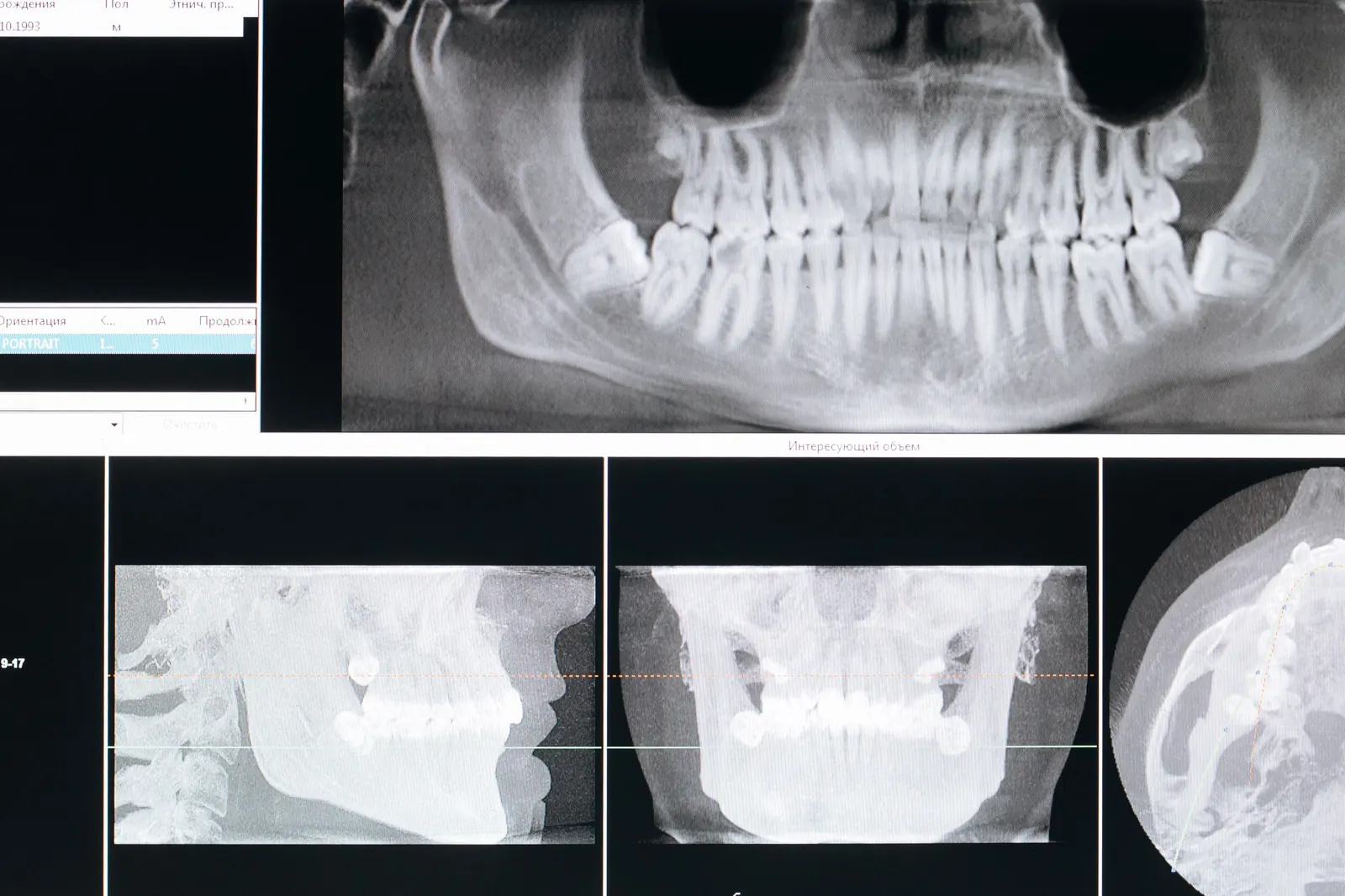
Panoramic X-ray for screening; MRI is the gold standard for disc position assessment in cases where it matters clinically. CBCT for bone changes or osteoarthritis evaluation.
The bruxism connection
Many patients with jaw clicking also have bruxism. The relationship is bidirectional — bruxism contributes to muscle tension that affects joint loading; existing joint dysfunction can contribute to bruxism patterns. Management of bruxism (custom night guard, sometimes Masseter Botox) often reduces clicking symptoms even when the disc displacement itself remains unchanged. Detailed bruxism guide.
For UK patients
NHS dental and medical assessment handles most jaw clicking adequately. The triage is straightforward — painless click without restriction needs reassurance only; symptomatic cases need conservative management; refractory cases warrant specialist referral. Dental tourism is rarely the right pathway for jaw clicking specifically — local management with continuity is generally better. Our broader TMD guide covers the related condition spectrum.
Frequently asked questions
Should I worry about my clicking jaw?
Probably not, if the click is painless and your opening range is normal. About 30% of adults have some disc displacement; many are entirely asymptomatic. Worry signals are pain, restriction, locking episodes, crepitus (grating), or progression of symptoms. Painless click without other symptoms can usually be observed without active treatment.
Will my jaw locking up be permanent?
Acute lock often resolves with prompt management — sometimes manual disc reduction by a clinician, sometimes spontaneously over hours. Chronic locked disc that has been present for weeks usually adapts; the joint reaches a new functional position with reduced opening. Most chronic locks improve substantially with conservative measures plus arthrocentesis if needed; surgical intervention is rarely required.
Can chiropractic fix a clicking jaw?
Chiropractic adjustments to the neck can be a useful adjunct in some cases — addressing postural contribution to TMJ loading. They are not primary treatment for jaw clicking and rarely change disc position directly. The published evidence for chiropractic in TMD is weaker than for dentistry or physiotherapy approaches.
Will my clicking get worse over time?
Often it does not. Many patients have stable disc displacement for decades without progression. The variables that worsen TMJ symptoms over time are bruxism, stress, joint overloading, and trauma — these are addressable. Without active worsening factors, the click pattern often remains stable.