Invisalign in Istanbul: When Clear Aligners Are the Right Choice
Invisalign is the dominant clear-aligner orthodontic system globally and the most common adult orthodontic treatment in the UK. The technology has improved substantially since the early systems; current clinical applicability covers most cases of mild to moderate complexity. Here is the realistic picture for UK patients considering Invisalign treatment in Istanbul.
How Invisalign actually works
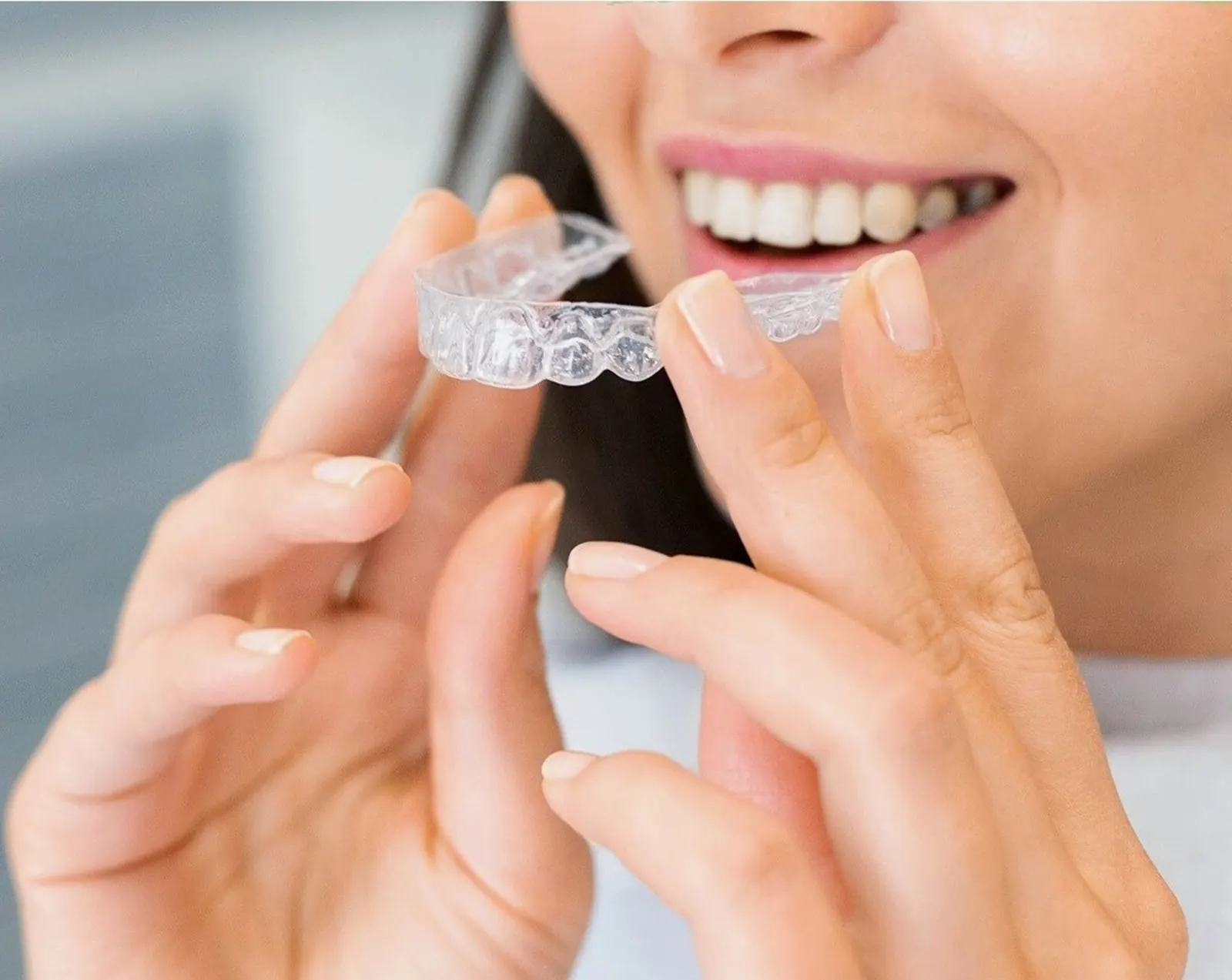
Invisalign uses a series of custom-made clear plastic trays (aligners), each worn for 7–14 days. Each tray applies controlled pressure to specific teeth, moving them gradually toward a planned final position. The total number of trays per case ranges from 14 (Invisalign Lite) to unlimited (Invisalign Comprehensive), reflecting case complexity.
The clinical workflow:
- Digital scan or impression of teeth.
- Treatment planning in ClinCheck software — the 3D simulation of tooth movement.
- Trays manufactured by Align Technology (the manufacturer) and shipped.
- Patient changes trays every 7–14 days, wearing each 22 hours daily.
- Periodic check-ins with the dentist (in-person every 6–8 weeks; remote video check-ins for some cases).
- Refinement scans if needed at the end of the planned series.
- Retention with a fixed wire or removable retainer indefinitely.
The three main Invisalign tiers
Invisalign Lite
Up to 14 aligners (about 6 months of treatment). Used for minor crowding, minor gap closure, minor rotation correction. Suitable for cases where the planned tooth movement is small and predictable.
Invisalign Moderate
Up to 26 aligners (about 9–14 months). Used for moderate crowding, moderate alignment correction, significant gap closure. The middle-ground tier covering most adult cases.
Invisalign Comprehensive
Unlimited aligners. Used for severe crowding, complex bite correction, cases requiring extractions, multi-arch coordination. Treatment time 12–24 months. Includes refinement scans at the end of the planned series for fine-tuning.
Where Invisalign works well
- Mild to moderate adult crowding.
- Gap closure (diastema).
- Tooth rotation correction.
- Crossbite correction.
- Mild deep bite correction.
- Minor alignment refinement after orthodontic relapse.
- Pre-restorative tooth movement before veneers or crowns.
Where Invisalign struggles
Aligners are excellent for tipping and rotating teeth, less reliable for moving roots through bone. The cases where fixed braces remain more predictable:
- Severe crowding requiring extractions.
- Significant vertical movement (intrusion or extrusion of teeth).
- Cases requiring substantial root movement.
- Severely tilted molars.
- Complex orthognathic surgery cases.
An honest case assessment includes whether Invisalign is the predictable option for the specific malocclusion. Marketing pressure to fit every case into Invisalign is common; the clinical reality is more selective.
Compliance: the limiting factor
Aligners must be worn 22 hours daily for predictable tooth movement. Removed only for eating and brushing. Patients who cannot consistently wear them — work that involves frequent eating, social anxiety about wearing aligners visibly, simple non-compliance — get unpredictable results.
If you anticipate compliance challenges, fixed braces (ceramic or lingual) are a better choice. Patients who are highly motivated and compliance-reliable get excellent results from Invisalign; patients who are not get poor results regardless of how good the system is.
Attachments and other adjuncts
Modern Invisalign uses small tooth-coloured composite “attachments” bonded to specific teeth — small humps that the aligners grip onto for harder movements. They are nearly invisible at conversational distance but visible up close. Removed at the end of treatment with no permanent effect on the tooth.
Other adjuncts:
- Interproximal reduction (IPR): selective enamel reduction (0.1–0.5 mm) at contact points to create space without extractions. Painless, performed at routine appointments.
- Elastics: small rubber bands worn between upper and lower aligner attachments, used for bite correction. Patient-applied each day.
- Retention: the post-treatment phase. Without retention, teeth tend to relapse to their original positions over years. Fixed wire retainer behind the lower (and sometimes upper) front teeth is the most reliable form.
The Istanbul-UK split-care model for Invisalign
Adult Invisalign is reasonably well suited to UK-Istanbul split care. The model:
- Initial in-person consultation in Istanbul, including digital scan and treatment planning.
- Aligner trays manufactured and shipped (or held in Istanbul for collection).
- Video check-ins every 6 weeks for routine progress.
- In-person review at 6 and 12 months for refinement decisions and attachment adjustments.
- Final review and retention at completion.
Suited to most cases of mild to moderate complexity. Not suited to fixed brace cases requiring monthly in-person adjustments or complex orthognathic cases. Pricing for the full Invisalign tier set is on the packages page; the entry tier covers most cases. Our broader adult orthodontics guide covers the full option spectrum including ceramic and lingual fixed braces.
Frequently asked questions
How long does Invisalign treatment take?
Invisalign Lite: 4–6 months. Invisalign Moderate: 9–14 months. Invisalign Comprehensive: 12–24 months. The variation depends on case complexity and patient compliance with 22-hour daily wear. Failed compliance extends treatment proportionally.
Is Invisalign as effective as fixed braces?
For mild to moderate cases — yes, with comparable published outcomes. For severe crowding, large vertical movements, complex bite correction, or extraction cases, fixed braces remain more predictable. The honest answer for any specific case requires examining the malocclusion, not relying on marketing.
Will Invisalign affect my speech?
Mild speech adjustment for 2–5 days as the tongue adapts to the aligners. Most patients adapt fully within a week. If your work involves public speaking, time the start of treatment accordingly.
Do I have to wear retainers forever?
Effectively yes. Without retention, teeth tend to relapse to their original positions over years, regardless of how successful the original treatment. Fixed wire retainers behind the lower front teeth are the most reliable; removable Vivera or Essix retainers worn nightly indefinitely are an alternative. Retention is part of the treatment, not optional.