Sinus Lift for Dental Implants: When It Is Necessary, How It Works
A sinus lift — clinically called sinus floor elevation — creates additional bone height in the upper jaw to allow implant placement when the maxillary sinus has descended after tooth loss. It is one of the more common pre-implant grafting procedures and well-established with predictable outcomes. Here is the practical clinical picture.
Why upper-jaw bone disappears after tooth loss
The maxillary sinuses are air-filled cavities in the cheekbones, just above the back upper teeth. When upper back teeth are present, the sinus floor sits at a stable height. When teeth are lost, two changes happen:
- The bone where the tooth was begins to resorb (normal post-extraction remodelling).
- The sinus expands downward into the space — pneumatisation of the sinus.
Over months to years, the bone height between sinus floor and ridge crest can drop from 12+ mm (adequate for implants) to 3–6 mm (inadequate). At that point, an implant cannot be placed without grafting.
When sinus lift is needed
The criterion is bone height. Most implant systems require:
- 10+ mm bone height for standard implant placement without grafting.
- 6–9 mm height: some short implants can be used, or a small “lateral window with simultaneous implant” approach.
- Less than 6 mm: sinus lift before or with implant placement.
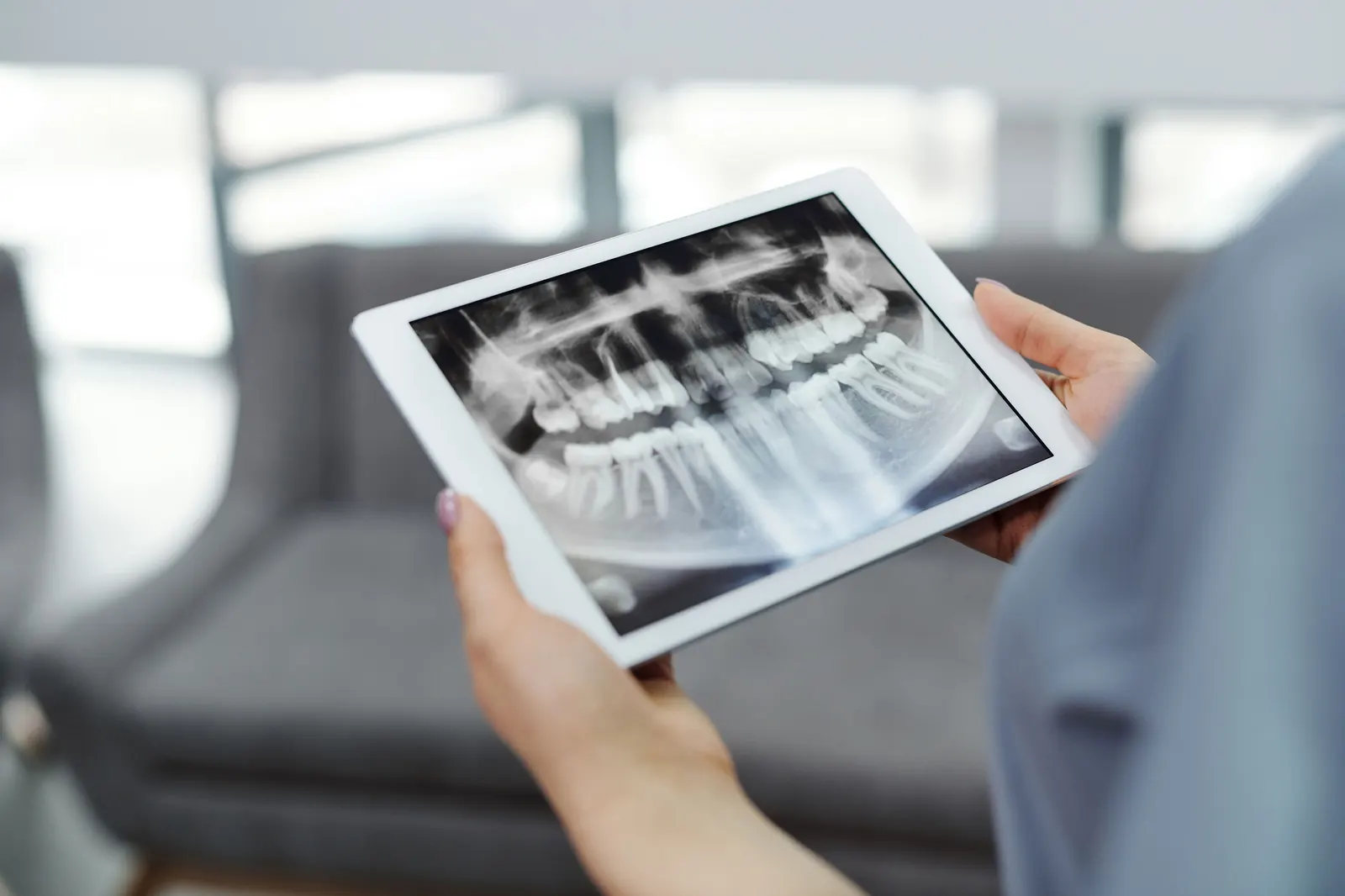
The CBCT scan measures bone height precisely. Panoramic X-ray gives an approximation; CBCT is needed for surgical planning.
The two main techniques
Lateral window sinus lift (open technique)
A small flap is raised on the cheek-side of the upper jaw, a small window is made in the bone over the sinus floor, the sinus membrane (Schneiderian membrane) is gently lifted upward, and graft material is placed in the space created. The window is closed with a collagen membrane.
Used for cases needing significant bone gain (4+ mm) or where the sinus floor is irregular. Healing 6 months before implant placement, sometimes simultaneous with the graft if enough native bone (4+ mm) remains for initial implant stability.
Crestal sinus lift (closed technique, Summers technique)
The osteotome approach — going through the implant site itself, using progressive osteotomes to fracture the sinus floor upward and pack graft material through the implant osteotomy. Less invasive than lateral window. Suited for smaller bone gain (2–4 mm) where the sinus floor is reasonably flat. Often performed simultaneous with implant placement.
Graft materials
Most cases use a xenograft (typically Bio-Oss, processed bovine bone). The material is non-biological — only the mineral scaffold remains after processing — and acts as a framework for the patient’s own bone to grow into. Lifespan of the graft as a scaffold is permanent in clinical use.
Alternatives include:
- Allograft (processed human donor bone) — avoids xenograft for patients who prefer human-source material.
- Autograft (patient’s own bone, harvested from elsewhere in the jaw) — best biological response but requires second surgical site.
- Synthetic alloplast (beta-TCP, hydroxyapatite) — fully synthetic alternative.
The procedure: what patients experience
- Local anaesthesia, sometimes with IV sedation for anxiety or longer cases.
- The procedure itself is generally not painful but the access is more involved than a routine extraction.
- Total chair time 60–90 minutes for unilateral case, 90–120 for bilateral.
- Suturing and post-op instructions covering the next 2 weeks.
Recovery
- Day 0–3: moderate swelling, some bruising on the cheek. Cold compress, OTC analgesia, soft food. Avoid blowing the nose forcefully — the pressure can dislodge the graft.
- Week 1: swelling reduces. Sutures removed at 7–10 days.
- Week 2–4: activity restrictions ease. Sneezing with the mouth open continues to be advised for 4–6 weeks.
- Month 6–9: graft has matured. CBCT confirms adequate bone height before implant placement (if not done simultaneously).
Risks and complications
- Sinus membrane perforation (5–30% in lateral window cases): the thin membrane tears during elevation. Small perforations can be repaired with collagen patches; large ones may require aborting the procedure and trying again in 2–3 months.
- Sinus infection (uncommon): typically responds to antibiotic treatment. More common in patients with pre-existing sinus pathology.
- Graft displacement (rare): the graft material moves into the sinus before stabilising. May resolve spontaneously or require minor revision.
- Failure to integrate (5–10%): the graft does not become bone. Identified at the post-graft check; revision is possible.
Modern technique with experienced surgeons has substantially reduced complication rates. Pre-operative CBCT and proper case selection are the main preventive factors.
Alternatives to sinus lift
For patients wishing to avoid sinus lift, alternatives:
- Short implants (6–8 mm length): can sometimes be placed in inadequate bone if width is adequate.
- Tilted (angled) implants in the All-on-4 configuration: avoid the sinus by angling implants in front of and behind it.
- Zygomatic implants: long implants that anchor in the cheekbone, bypassing the maxillary sinus entirely. Used for severe bone loss.
- Bridge or denture replacement: non-implant options if implant treatment is not practical.
Our broader bone graft guide covers the full spectrum of pre-implant grafting.
For UK patients considering Istanbul treatment
Sinus lift is part of the implant treatment package when needed. The pricing tier structure is on the packages page; sinus lift is part of the complex case (T5) tier or added to standard implant tier (T2) where bone permits. Two-trip protocol is common — graft on first trip, implant placement after 6 months on second trip. Same-trip placement is feasible only when bone volume is borderline (≥4 mm). UK pricing for sinus lift typically £1,000–£2,500 per side at private clinics.
Frequently asked questions
How painful is a sinus lift?
The procedure is performed under local anaesthesia and is not painful. Post-operative discomfort is moderate for 3–5 days, controlled by paracetamol-ibuprofen rotation. Most patients return to normal activity within a week. Bilateral cases are more uncomfortable than unilateral.
How long until I can have implants after a sinus lift?
For lateral window cases without simultaneous implant: 6–9 months for graft maturation before implant placement. For crestal lift cases with simultaneous implant: implant is in place from day one but takes the same 4–6 month osseointegration period before crown loading. The total timeline from start to final crown is similar in both approaches.
Is sinus lift safe?
Yes when performed by experienced surgeons with proper imaging and technique. Modern complication rates are low; the most common complication (sinus membrane perforation) is manageable in most cases. Pre-operative CBCT and proper case selection reduce risk substantially. Patients with pre-existing sinus pathology need ENT clearance before grafting.
Can I avoid a sinus lift with short implants?
Sometimes — short implants (6 mm length) can be placed in 7–8 mm of bone, avoiding the lift in borderline cases. The published outcomes for short implants are now adequate for routine use. The decision depends on the specific bone height and the implant system available. Tilted implant placement (All-on-4 geometry) is another sinus-avoiding option for full-arch cases.