Dental Clinic Hygiene Standards in Istanbul: What UK Patients Should Verify
The fear of cross-infection or sterilisation failure is one of the most common concerns for UK patients considering dental treatment in Istanbul. The honest answer: standards vary across clinics, but the protocols required to meet international expectations are well-defined and verifiable. Here is the checklist UK patients should run before booking any treatment.
The international standards that apply
Dental sterilisation in any developed country is governed by:
- ISO 17665 for steam sterilisation (autoclave) parameters and validation.
- ISO 14937 for sterilisation processes generally.
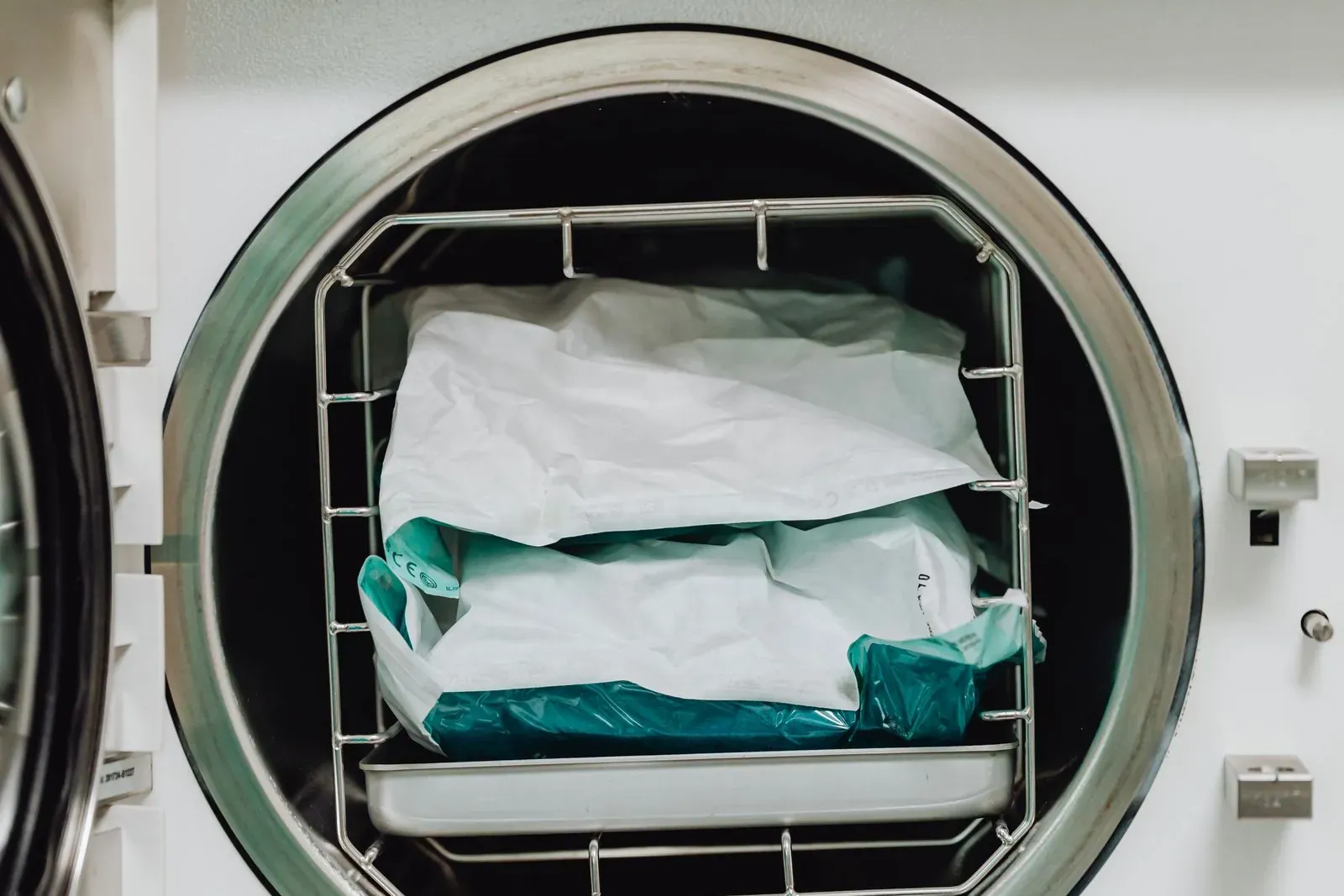
- EN 13060 for small steam sterilisers (the Class B autoclaves used in dental clinics).
- National regulations — in the UK, HTM 01-05 (Health Technical Memorandum) governs decontamination in dental practices. Turkey has Ministry of Health regulations of equivalent technical scope.
Properly equipped dental clinics in Istanbul comply with these standards because the equipment, protocols, and training are essentially identical to UK practice. The variation between clinics is not in what the standards require — it is in how rigorously each clinic actually implements them.
What sterilisation actually involves
The decontamination cycle for dental instruments has six steps:
- Pre-cleaning: instruments are rinsed and pre-treated immediately after use to prevent organic material drying onto surfaces.
- Manual or ultrasonic cleaning: mechanical removal of debris.
- Inspection: visual check for residual debris or damage.
- Packaging: instruments sealed in pouches with chemical indicator strips that change colour at correct sterilisation parameters.
- Sterilisation: autoclave at 134°C for 3 minutes (or equivalent cycle), with each cycle logged.
- Storage: sealed pouches stored in clean, dry conditions until use, with shelf life tracking.
A clinic that takes shortcuts in any of these steps creates infection risk. The verification points are observable.
What you can directly observe
On a clinic tour or during your first appointment, these are the practical verification points:
- Single-use items: needles, scalpel blades, suction tips, and prophylaxis cups should be unwrapped from sealed packaging in front of you. If they appear ready-to-use without packaging, ask why.
- Glove and mask change: gloves should be put on and removed in front of you; the dentist should change masks between patients.
- Surface barrier or wipe-down: dental chair surfaces, light handles, and computer keyboards should be either covered with single-use barriers or wiped with hospital-grade disinfectant between patients.
- Sterilisation pouches: instruments come out of a sealed pouch with a colour-changed chemical indicator. The pouch should be opened in front of you.
- Chair-side ultrasonic and autoclave: visible in the clinic. Ask to see the sterilisation room briefly. Reputable clinics will tour you through.
What to ask the clinic in writing before booking
Reasonable questions for any clinic, in any country:
- Which autoclave brand and model do you use? (B-class small steam steriliser is the standard.)
- How often is the autoclave service-validated? (Annual minimum, with documentation.)
- Do you keep sterilisation cycle logs? (Yes is the answer; you can ask to see one.)
- How are infectious materials (needles, blades) disposed of? (Sharps bins, with a registered waste contractor.)
- What is your protocol for known blood-borne infectious patients? (Standard precautions apply to all patients regardless; specific clarifications are welcome.)
The Turkey-specific considerations
Two factors matter for UK patients considering Istanbul:
JCI accreditation
Joint Commission International accreditation is held by some Istanbul hospitals and a small number of dental clinics. JCI accreditation is rigorous and meaningful. However: most dental clinics in Istanbul do not have JCI accreditation, and this does not by itself indicate a hygiene problem. JCI accreditation is expensive and oriented toward larger institutions; many excellent dental clinics meet equivalent standards without the formal accreditation. Treat JCI as a positive signal where present, not a binary requirement.
Turkish Ministry of Health licensing
All licensed dental clinics in Turkey are inspected by the Ministry of Health. The license number can be verified. Active inspection programs cover sterilisation, infection control, qualified staffing, and material lot tracking. This is the regulatory baseline.
Material lot tracking: the additional layer
For implant work specifically, lot tracking adds an additional verification: every implant placed in a regulated clinic is recorded with its manufacturer lot number, allowing later traceability if there is a manufacturer recall or quality concern. We provide this lot certification at discharge for every implant case. This is a Turkish Ministry of Health requirement — not specific to our clinic — but the documentation should appear in your records pack regardless.
What you do not need to verify
Some concerns from forum reading are not actually relevant:
- Water quality: dental units use water filtered through internal lines. Tap water concerns are not relevant to dental treatment specifically.
- Air conditioning: infection transmission via air is essentially not a thing in dentistry. Dental aerosol concerns relate to droplet spread in immediate proximity, controlled by routine PPE and high-volume suction.
- Building age: a clinic in an older building can have modern equipment and impeccable protocols. The protocols matter, not the building.
Our protocols at GC Clinic
For transparency: we use B-class autoclaves with cycle logging, single-use sharps and consumables, full PPE protocols including face shields for aerosol-generating procedures, and lot-tracked implant materials. Sterilisation room is available for patient inspection on request. Our hygiene protocols are reviewed quarterly and audited externally annually. Our broader Turkey safety guide covers context beyond hygiene specifically.
Frequently asked questions
How can I verify a dental clinic’s sterilisation standards before booking?
Ask in writing about autoclave class (B-class is the standard), service validation frequency (annual), sterilisation cycle logging, and request a clinic tour. Reputable clinics will answer in detail and welcome the inspection. Vague or evasive answers are a signal to look elsewhere.
Should I only use a JCI-accredited dental clinic in Turkey?
JCI accreditation is a strong positive signal where present, but not a binary requirement. Many excellent dental clinics in Istanbul meet equivalent international standards without the formal accreditation, which is expensive and oriented toward larger institutions. Use JCI as one of multiple verification points, not the only one.
What infection control questions should I ask?
Single-use protocols for needles, blades, suction tips. Sterilisation pouches opened in front of you. Surface barriers or wipe-down between patients. Glove and mask change. Sharps bin and registered waste contractor. Material lot tracking for implants. These are observable on the day; written answers reasonable to request beforehand.
Are Turkish dental clinic standards lower than UK clinics?
The standards are the same internationally — ISO 17665 sterilisation, B-class autoclaves, single-use protocols. The variation is in implementation, not in what the standards require. Properly equipped clinics in Istanbul meet UK-equivalent standards. The verification process is the same as you would use for any UK private clinic.