Minimally invasive dentistry is our default clinical stance — not a separate treatment, but the lens we look at every case through. That means: before a crown, we ask whether a partial crown will do. Before a partial crown, an onlay. Before an onlay, a composite filling. Before an implant, whether the tooth can still be saved. Before twenty veneers, whether ten are enough. Conservative dental treatment, written into your plan in 4 hours — and the deliberate counter-position to "Turkey Teeth".
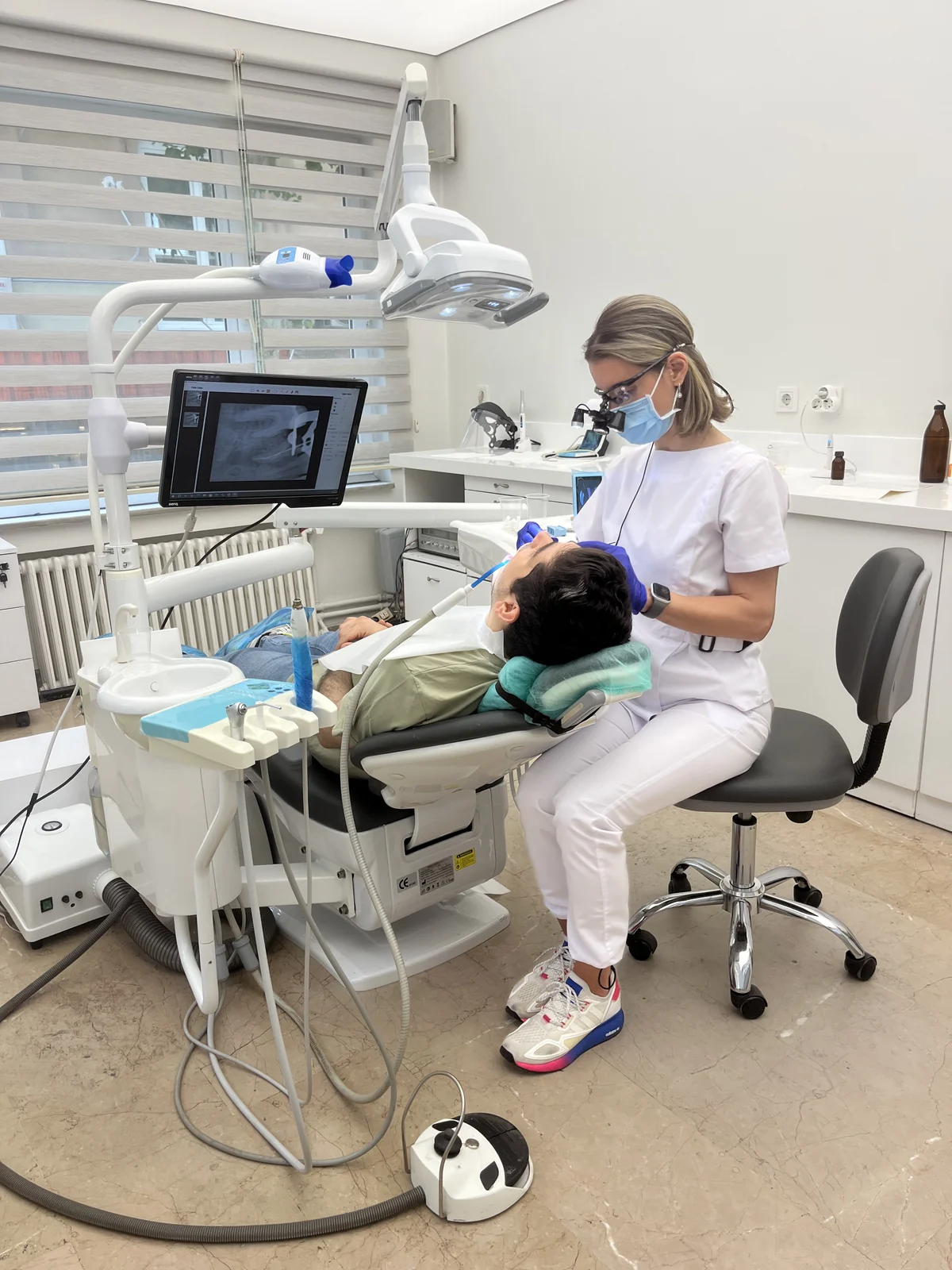
Before we extract a tooth and replace it with an implant, we check whether endodontic re-treatment, apical surgery or periodontal therapy can still save it. Your own tooth with a 20-year prognosis is worth more than a premium implant — no implant is functionally equivalent to a healthy natural tooth.
Modern adhesive systems (universal bonds, self-etch, composite cementation) allow restorations without circumferential tooth preparation. Instead of a crown with 1.5–2 mm preparation all the way around, a veneer with 0.3–0.5 mm micro-preparation in the enamel alone may be enough. That is more conservative, and easier to repair years later.
Composite bonding is reversible (polish it off and the tooth returns to its starting point). A veneer is partly reversible — most of the enamel remains. A full crown is not reversible. When two clinical options are equivalent, we choose the more reversible one. You may want to decide differently in ten years; we keep that door open.
"It's a cleaner cut so the crown seats better" is not a sufficient reason if a minimally prepared option also works. This is the direct opposite of the "Turkey Teeth" mindset, where twenty healthy teeth are heavily prepared just to fit uniform crowns.
If a small piece of a crown chips, or a composite restoration loses a corner, we repair directly — not remake the whole crown. That preserves tooth structure, costs less, and means less trauma. Many practices earn more from full remakes; that is often why a different recommendation is offered. We don't do it that way.
Five clinical situations where "maximally invasive" (left) and "minimally invasive" (right) approaches lead to very different outcomes. Not every clinic decides the same way. We are consistently on the right.
UK dental schools — Guy's, Eastman, Liverpool, Manchester, Birmingham — have long held a quietly conservative line on tooth preservation. The British practitioner culture trained under names like the late Professor Edwina Kidd at King's, and a generation of cariologists, has consistently published on minimal intervention, adhesive techniques and composite restoration. Most thoughtful private UK practices work in that tradition: save the tooth before replacing it.
Our approach sits with that, not against it. Dt. Zerrin Engin Bakkal's Berlin doctorate in periodontology (1983) under Professor Bernimoulin comes from the same tradition: understand the soft tissue and the natural tooth first, then decide whether to operate. Dr. G. Cansu Öztürk — an endodontist with specialist training (ESE & AAE member) — is the modern continuation: tooth preservation as the first priority.
What separates us from the average dental tourism provider: we don't do minimally invasive dentistry as a side option, we do it as our default stance. When a high-volume chain has to handle twenty patients in a day, there is simply not enough time for tooth-saving detail work. With a maximum of six patients per day for Dr. Öztürk, that detail work is mathematically possible. Records you take home are NHS-compatible, so your UK GDC-registered dentist can read them on day one.
No crown without a written indication. No "let's prepare it generously so the crown seats nicely" — that is not a clinical reason.
An implant goes onto the plan only after a recorded salvageability check — endodontic re-treatment, apical surgery, periodontal rehabilitation, where indicated.
We decline patient requests for 16+ crowns over predominantly healthy teeth. That is not treatment, it is overtreatment. Roughly 5% of enquiries are turned away on those grounds.
Before remaking a fractured crown, we assess for bruxism. If positive: night guard first. Otherwise the replacement crown breaks too.
Endodontics without an operating microscope is guesswork. We do no root canal treatment without one.
Without rubber dam there is no reliable adhesion. Practices that skip rubber dam "for time" compromise long-term bond strength. We don't.
If composite and veneer both work, we recommend composite. That is not in our financial interest — it is in yours. That is the point.
Every minimally invasive plan ships with NHS-compatible records for your UK dentist or GP, lot-numbered material documentation, and our written warranty cover: 10 years on implants, 5 years on crowns and veneers, 2 years on endodontic treatment, 1 year on soft tissue. WhatsApp reply within 30 minutes whenever you have a question.
Often, the maximally prepared option is not the only one available. We will show you the more conservative route if it exists. Free second opinion · WhatsApp reply within 30 minutes · written treatment plan within 4 hours.